Managing employees efficiently is no longer optional—it’s a necessity for growing businesses.
Yet many companies still confuse HRMS software with payroll software, assuming they serve the same purpose.
The truth? They don’t.
In this guide, you’ll learn:
- What HRMS software is
- How it differs from payroll software
- Why businesses are switching to HRMS
- Which solution is best for you
What is HRMS Software?
HRMS (Human Resource Management System) is an all-in-one platform that helps businesses manage their entire workforce from a single system.
It includes:
- Employee management
- Attendance & leave tracking
- Payroll processing
- Performance tracking
- Compliance & reporting
In simple terms:
HRMS manages people, processes, and data together.
HRMS vs Payroll Software: Key Differences
Many businesses start with payroll software—but quickly outgrow it.
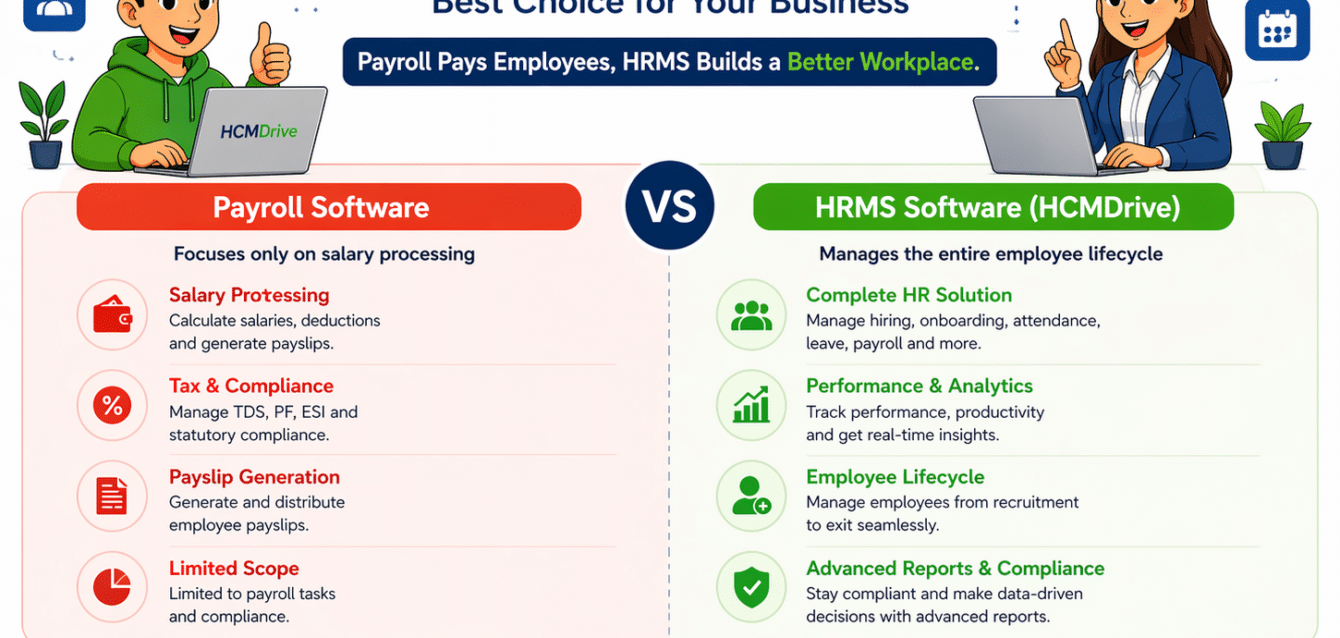
Payroll Software:
- Focuses only on salary processing
- Handles tax calculations & compliance
- Generates payslips
- Limited HR functionality
HRMS Software:
- Manages full employee lifecycle
- Includes attendance, payroll, and performance
- Supports hiring & onboarding
- Provides analytics & insights
Simple difference:
Payroll pays employees. HRMS builds and manages your workforce.
Why Do Companies Need HRMS in 2026?
As businesses grow, manual HR processes become inefficient and error-prone.
Here’s why HRMS is essential:
1. Automation
Automates repetitive HR tasks and saves time
2. Accuracy
Reduces human errors in payroll and data
3. Compliance
Helps meet labor laws and regulations
4. Data-Driven Decisions
Provides real-time insights for better planning
5. Employee Satisfaction
Improves transparency and engagement
HRMS is not an expense—it’s an investment in growth.
Top Benefits of Using HRMS Software
Save Time
Automate daily HR operations and reduce manual work
Reduce Costs
Minimize errors and operational expenses
Increase Productivity
Free HR teams to focus on strategic tasks
Secure & Reliable
Protect sensitive employee data
Scalable Solution
Perfect for startups, SMEs, and enterprises
Is HRMS Worth It for Small Businesses?
Absolutely.
Many small businesses think HRMS is only for large companies—but that’s a myth.
In fact, HRMS helps small businesses even more by:
- Organizing employee data
- Tracking attendance easily
- Running accurate payroll
- Making smarter decisions
Start small, but think long-term.
HRMS vs Payroll: Which One Should You Choose?
Choose Payroll Software if:
- You only need salary processing
- You have a very small team
Choose HRMS if:
- Your team is growing
- You want automation
- You need better insights
- You want to scale efficiently
For most growing businesses, HRMS is the smarter choice.
Why Choose HCMDrive HRMS?
Modern businesses need more than just payroll—they need a complete HR solution.
HCMDrive HRMS helps you:
✔ Automate HR processes
✔ Manage employees in one place
✔ Improve productivity
✔ Ensure compliance
✔ Make data-driven decisions
It’s designed for businesses that want to grow smarter, not harder.
Final Thoughts
The difference between HRMS and payroll software is simple:
Payroll handles salaries
HRMS manages your entire workforce
If you’re planning to scale your business, investing in HRMS is no longer optional—it’s essential.