Human Resources teams are expected to do more than manage employee records, process salaries, and coordinate recruitment. Today, HR leaders must also improve employee experience, make informed workforce decisions, and support business growth.
However, many HR departments still spend valuable time on repetitive tasks such as screening resumes, answering employee queries, tracking attendance, checking payroll information, and following up on training.
This is where agentic AI in HR is becoming an important topic for modern businesses. Unlike traditional automation that follows predefined rules, agentic AI can help plan and coordinate multi-step tasks, depending on its capabilities, permissions, and level of human supervision.
For HR managers, CHROs, and business leaders, understanding this technology can help identify which workflows are suitable for automation and where human judgement remains essential.
In this guide, we explore how agentic AI can support recruitment, payroll, onboarding, employee management, and other HR functions in 2026.
What Is Agentic AI in HR?
Agentic AI in HR refers to AI systems designed to pursue a defined goal by planning steps, using available tools, and coordinating tasks with varying levels of autonomy.
For example, a traditional HR chatbot might explain the onboarding process to a new employee. An agentic system, if properly integrated and authorized, could help collect required documents, trigger onboarding tasks, send reminders, and update workflow statuses.
The distinction is important: not every AI chatbot or automated HR workflow is an AI agent. Capabilities differ between platforms, and consequential actions should have appropriate approval controls.
Modern HR technology can combine AI with an HRMS software platform to connect employee information, recruitment, payroll, attendance, and performance workflows. The objective is to reduce repetitive work while allowing HR professionals to focus on people and business priorities.
Why Is Agentic AI Becoming Important for HR Teams?
HR departments often work across disconnected applications, spreadsheets, emails, and manual approval processes. This creates delays, inconsistent records, and unnecessary administrative work.
Recent HR industry coverage increasingly discusses AI that moves beyond generating answers toward coordinating tasks and supporting decisions. At the same time, privacy, bias, accountability, and human oversight remain important considerations.
Here are some potential benefits:
- Less repetitive administration: Automate routine reminders, document requests, and workflow updates.
- Faster coordination: Connect related tasks across recruitment, onboarding, and employee management.
- Better access to information: Help authorized employees find relevant policies and HR information.
- Improved visibility: Track outstanding tasks, exceptions, and workflow progress.
- More time for strategic HR: Give HR teams more opportunities to focus on employee engagement, workforce planning, and talent development.
These benefits depend on the quality of employee data, system integration, process design, and appropriate governance.
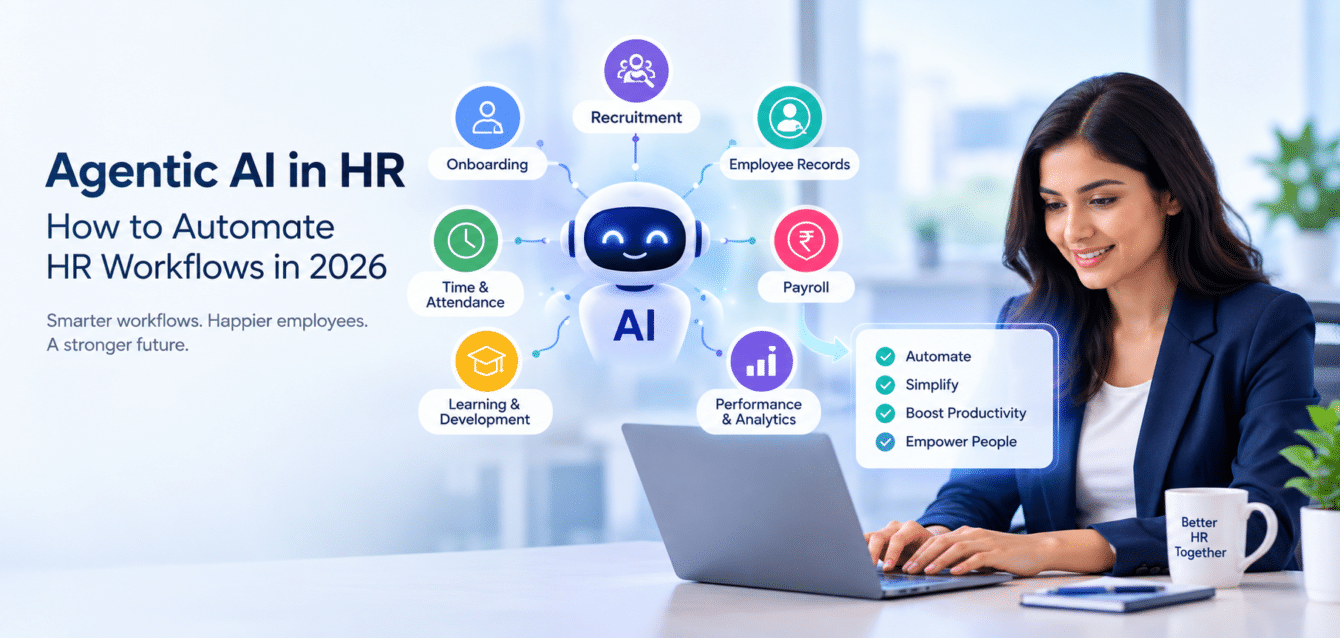
7 Ways Agentic AI Can Automate HR Workflows
1. Recruitment and Candidate Management
Recruitment involves multiple activities, from publishing job openings to coordinating interviews and communicating with candidates.
AI-supported recruitment workflows can help HR teams:
- Organize and categorize incoming applications.
- Identify candidate profiles that match predefined job requirements.
- Prepare interview questions and summarize candidate information.
- Coordinate interview schedules and send reminders.
- Track application progress and outstanding recruitment tasks.
For example, when an application arrives, an integrated workflow could organize the candidate’s details, notify the recruiter, and prepare the next steps for review.
AI should not make final hiring decisions without appropriate human oversight. Candidate screening criteria should be job-related, consistent, and regularly reviewed for potential bias.
Explore HCMDrive’s recruitment management solution to understand how recruitment workflows fit into a broader HR process.
2. Employee Onboarding Automation
A new employee may need to submit documents, complete forms, receive equipment, attend orientation, and meet with a manager.
When these activities are managed manually, important steps can be delayed or forgotten.
Agentic AI-enabled workflows could help by:
- Sending personalized onboarding instructions.
- Tracking outstanding documents and approvals.
- Reminding employees and managers about pending activities.
- Coordinating orientation sessions and training assignments.
- Updating onboarding progress for authorized HR staff.
For example, once an offer is accepted, a workflow could initiate document collection and notify the relevant departments. Sensitive actions, such as granting system access, should remain subject to the company’s security policies and approval requirements.
Read more about employee onboarding processes and how structured workflows can improve the new-hire experience.
3. Payroll Processing and Exception Detection
Payroll requires accurate employee information, attendance records, salary structures, approved changes, and applicable statutory calculations.
AI can assist with reviewing payroll inputs and identifying unusual values before payroll is finalized.
Potential use cases include:
- Flagging unusual salary or overtime entries.
- Identifying missing attendance or leave information.
- Reminding managers about pending approvals.
- Helping payroll teams investigate discrepancies.
- Preparing summaries of payroll exceptions for review.
For example, if an employee’s recorded overtime differs significantly from the approved schedule, a system could flag the discrepancy for investigation rather than automatically changing the employee’s salary.
Payroll calculations and statutory obligations must be validated against applicable rules. AI-generated recommendations should not replace required payroll controls.
Businesses can explore HCMDrive’s payroll management solution for information about payroll workflows, salary calculations, and compliance-related processes.
4. Employee Records and HR Queries
Employee information is often spread across documents, spreadsheets, and different business applications. This can make routine HR requests unnecessarily time-consuming.
With suitable integrations and access permissions, AI-supported workflows can help employees and HR teams:
- Locate relevant HR policies and procedures.
- Find authorized employee information.
- Route leave, document, or employment-related requests.
- Remind employees about incomplete forms.
- Keep approved employee record changes organized.
For example, an employee asking about a leave policy could receive an answer based on the company’s approved documentation. A request to change personal or payroll information could then be routed through the required verification process.
Confidential employee records must remain protected by role-based access controls, authentication, and appropriate data-handling policies.
Explore HCMDrive’s Employee Core solution for employee data management.
5. Attendance, Leave, and Workforce Scheduling
Managing attendance becomes more complex when organizations have multiple locations, shifts, departments, and employee schedules.
AI-assisted automation can help HR teams:
- Identify missing attendance entries.
- Flag potential inconsistencies in time records.
- Send reminders about pending leave approvals.
- Support shift and roster planning.
- Prepare attendance summaries for payroll review.
For example, if an attendance record is incomplete, the system could notify the employee or manager and track the issue until it is resolved.
The goal is not to penalize employees automatically. Attendance exceptions should be investigated fairly, with employees given an opportunity to correct inaccurate information.
HCMDrive’s Time Management solution is a relevant internal resource for readers interested in attendance tracking and workforce scheduling.
6. Employee Learning and Performance Management
Organizations need to continuously develop employee skills as roles, technologies, and business requirements change.
AI-supported HR workflows can help identify training needs and coordinate learning activities.
Possible applications include:
- Recommending learning resources based on job roles and skill gaps.
- Assigning required training courses.
- Sending reminders about incomplete learning activities.
- Tracking certification progress.
- Summarizing performance goals and development plans for review.
For example, when a team needs to develop a new technical skill, an integrated learning workflow could help HR identify relevant courses, coordinate enrollment, and monitor completion.
Training recommendations should be relevant to the employee’s role and career goals. Performance assessments should also consider context and human feedback rather than relying entirely on automated scores.
Explore HCMDrive’s Learning Management solution and Performance Management System for related workforce development capabilities.
7. HR Analytics and Workforce Planning
HR leaders need reliable information to understand workforce trends and plan for future requirements.
AI-assisted analytics can help organize workforce data, summarize patterns, and identify areas that deserve further investigation.
Examples include:
- Reviewing hiring trends and recruitment bottlenecks.
- Monitoring workforce turnover patterns.
- Identifying potential skill gaps.
- Summarizing training participation.
- Preparing workforce reports for management.
For instance, an HR analytics workflow might identify a department with increasing turnover and prompt HR to examine workload, employee feedback, management practices, and retention strategies.
Predictions should be treated as signals for investigation, not as proof of an employee’s future behaviour. Sensitive employment decisions require careful human review.
How to Implement Agentic AI in HR Successfully
Adopting AI does not mean automating every HR activity immediately. A phased approach helps organizations understand the benefits and risks before expanding automation.
Step 1: Identify repetitive workflows
Start with processes such as reminders, document collection, routine employee queries, and workflow status updates.
Step 2: Improve employee data quality
Review duplicate records, missing fields, inconsistent formats, and outdated information. AI systems cannot reliably coordinate processes when the underlying data is inaccurate.
Step 3: Check system integration
Determine whether your HRMS can securely connect recruitment, employee records, payroll, attendance, and learning systems.
Step 4: Define approval and access controls
Establish which tasks AI may perform independently, which require approval, and which must always remain under human control.
Step 5: Run a controlled pilot
Choose one workflow, measure its baseline performance, and compare results after implementation.
Useful measures include processing time, error rates, outstanding tasks, employee satisfaction, and the amount of manual work required.
Step 6: Monitor results and risks
Review accuracy, privacy, access permissions, employee feedback, and unexpected outcomes regularly. Expand only when the workflow performs reliably.
What Should Businesses Consider Before Choosing AI-Powered HR Software?
Before selecting a platform, HR leaders should evaluate more than its AI features.
Consider the following:
- Integration: Can the platform connect relevant HR processes without creating unnecessary data silos?
- Security: Are employee records protected through suitable access controls and security measures?
- Transparency: Can HR teams understand why an action was suggested or an exception was flagged?
- Human oversight: Can consequential decisions be reviewed and corrected by authorized people?
- Compliance: Can the organization meet the legal and regulatory requirements of the countries where it operates?
- Scalability: Can the platform support changing workforce sizes, processes, and business requirements?
- Measurable value: Does the solution improve a defined business outcome rather than simply adding another AI feature?
For businesses operating in India and the UAE, payroll rules, employment requirements, privacy obligations, and system requirements should be assessed separately for each applicable jurisdiction.
The right platform should support the organization’s actual workflows and governance requirements rather than relying on AI claims alone.
Frequently Asked Questions (FAQs)
1. What is agentic AI in HR?
Agentic AI in HR refers to AI systems that can plan and coordinate multi-step tasks toward a defined goal, using available tools and permissions. Depending on the system, it may assist with recruitment, onboarding, employee queries, and workflow management.
2. How is agentic AI different from traditional HR automation?
Traditional automation generally follows predefined rules and triggers. Agentic AI can potentially plan a sequence of actions and adapt to changing information within defined limits. Both approaches can work together in an HRMS.
3. Can agentic AI automate payroll processing?
AI can assist with payroll validation, anomaly detection, missing information, and approval reminders. Final payroll calculations, compliance checks, and salary payments should follow appropriate validation and authorization procedures.
4. Is agentic AI useful for small and medium-sized businesses?
Yes, it can be useful when businesses have repetitive HR tasks and clearly defined workflows. Organizations should start with manageable use cases and evaluate the cost, integration effort, security, and measurable benefits before expanding.
5. What are the risks of using AI in HR?
Key risks include inaccurate outputs, biased recommendations, employee-data exposure, excessive automation, and unclear accountability. Organizations should use appropriate security controls, testing, monitoring, and human oversight.
6. How does HRMS software support AI automation?
An HRMS can provide structured employee information and connect workflows across recruitment, onboarding, attendance, payroll, and performance management. AI capabilities depend on the platform’s actual features, integrations, and permissions.
Conclusion
Agentic AI has the potential to change how HR teams coordinate everyday work, from recruitment and onboarding to payroll, employee development, and workforce analytics. However, successful adoption requires more than advanced technology. Accurate data, secure integrations, clear approval processes, and human oversight are essential to achieving reliable results.
Businesses should begin with repetitive, measurable workflows, evaluate the results, and expand automation gradually. The objective is to make HR processes more efficient while preserving fairness, privacy, and the human judgement needed for important employee decisions.
HCMDrive helps businesses explore integrated workforce management through solutions covering recruitment, employee records, time management, payroll, onboarding, learning, and performance management. Explore the HCMDrive website to learn more about its HR technology solutions and identify the workflows that best fit your organization’s needs.